Most recently, and in the past, governments have bailed out several companies and banks. The argument is that bailouts are necessary to prevent economic disasters. Government bailouts have become bigger and bigger all in the pursuit of avoiding an economic catastrophe.
GM Bailout
 The GM bailout exceeded 50 billion dollars and also included a special tax break for GM which allowed the company to write off approximately 45 billion dollars in post-bankruptcy losses against post-bankruptcy profits (Levey 2012). The result of this was a record profit of 7.6 billion dollars in 2011. This was the highest profit in the company’s 100 year history according to President Obama. GM’s tax break is good for twenty years. So, while the American taxpayer was paying taxes, GM was receiving a check for 110 million dollars (Levey 2012). The GM bailout, although appearing to be one-sided was a necessary measure in the overall bigger picture of the economic success of our nation.
Government Bailouts of other Companies
In 1907 F.A. Heinze’s losses in the copper industry based on speculation of market trends sent ripples throughout the economy. Losses resulted in the failure of many investors including the Knickerbocker Trust Company of New York. This bank’s failure caused a stock market crash in 1907.
J.P. Morgan organized themselves with the United States Treasury and other wealthy bankers to provide millions of dollars in bailout money in order to avert economic collapse.
Government Bailout for Lockheed Aircraft Corporation and Chrysler
In 1971 Lockheed Aircraft Corporation was facing bankruptcy during a production run on a new line of jets. Lockheed stated that without a government bailout, the company would have to lay off 60,000 workers and companies that did business with them would also suffer. The government bailed out Lockheed to the tune of 250 million dollars and that allowed the company to avoid bankruptcy even though later in the 1980s they finally stopped producing commercial jets.
In 1980, Chrysler was facing bankruptcy and Lee Iacocca lobbied for 1.5 billion dollars in bailout money to help avoid bankruptcy. President Jimmy Carter authorized the loan in that same year and Chrysler paid off the loan in 1983.
Government Bailout for Savings and Loan Banks
 The savings and loan collapse in the 1980s was estimated to cost taxpayers 124 billion dollars. The crisis started back in the 70s when they first started o struggle financially. Savings and loan banks mainly made mortgages but because these institutions were required to maintain low interest rates by law, it made it hard to compete and customers moved their money to other institutions. After the government deregulated the savings and loan industry and removed the ceiling on interest rates in 1980, institutions began making reckless investments, which caused a collapse. Congress passed the Financial Institutions Reform, Recovery, and Enforcement Act in 1989, which was an expensive bank bailout to rescue the troubled industry (2009).
Government Bailout for the Housing market
 The housing crisis of 2008 had its start in 2001 when we experienced the “dot-com-bubble” and the terrorist attacks of September 11th. In an attempt to rejuvenate the struggling economy, the Federal Reserve lowered interest rates substantially. Mortgage companies took advantage of this and started offering very low introductory rate, variable interest rate mortgages to any customer needing a mortgage, including subprime customers who may have a difficult time making mortgage payments. When the many adjustable-rate mortgages began to increase in 2007, many homeowners could not make their mortgage payments and lost their homes. Housing prices began to fall and the economy was affected. Unemployment began to rise, the stock market began to tumble and the country went into a recession. The fear of the mortgage giants going bankrupt and the economy collapsing led Congress to pass a $300 billion bank bailout housing bill in July 2008 providing emergency funds for both lenders and borrowers.
Conclusion
Should the government be responsible to bailout financial institutions to avert an economic disaster? This is a question many ask themselves. The government has a responsibility to make sure the United States economy does not flounder. We appoint officials to office in hopes that they have the insight and knowledge to make the right decisions for the betterment of the people and this nation.
Sources:
Associated Press. (2010). Financial Bailout may Cost Less Than Thought. Retrieved from http://www.nytimes.com/2010/12/17/business/17tarp.html
“Government Bailouts.” Issues & Controversies On File: n. pag. Issues & Controversies. Facts On File News Services, 30 Mar. 2009. Web. 20 May 2012.
Levey, C. (2012). What the GM Bailout Really Cost American Taxpayers. Retrieved from http://www.foxnews.com/opinion/2012/05/18/what-gm-bailout-really-cost-am…

 The Iron Man exoskeleton has to be the most technical of all superhero equipment. Tony Stark’s genius is enjoyed in the magnificence of the Iron Man suit.
 Doctor Octopus, Otto Octavius, is a genius and master inventor. He created mechanical arms that are not only great gadgets, but also provide extra appendages to create more villainous items.
 Recently I read an article called “Employee Disciplining – What is discipline and how do the managers administer it?” by J.T. Knippen and T.B. Green (PM Magazine vol 8, no 3). This article deals with discipline in the workplace. What it is, why managers need to know how it is used, when it should be used and how to go about using discipline.
 The relationship between business and society is integral in the success of any business. This relationship is defined as how a company interacts with society. There is an obvious and symbolic relationship between business and society that has been observed and evaluated for generations. Because of our social nature, we humans like to be included in a group of people like ourselves that make us feel the sense of being with others and having a discussion as a part of the exchange of ideas. This situation exists in all forms of our society and includes business, family and all sorts of groups and entities. Thus we can say that human beings are social elements and like to be with others like them. This makes the foundation of strong connection between business and society. Thus it is important to consider the social factors for efficient functioning of the operations of an organization. The important fact to remember is that business is about relationships and a successful firm is the one that is able to build good and long-lasting relationships with its customers.
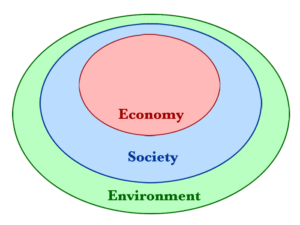 Today’s market is filled with competition. Every industry must raise the level of importance to maintain good relationships with customers so that they can stay connected with the organization even during the event when the competition is offering better prices and better services. Therefore all efforts put toward building good relationships is time well spent. Many organizations form special departments solely for the purpose of maintaining relationships with the customers and employees in the firm. Strong relationships are needed to exist with the management committee at the topmost level in the firm. Thus the importance of relationship between business and society is not hidden from anyone and is well evident everywhere and the firms today need to focus at this aspect more than anything else to ensure success.